
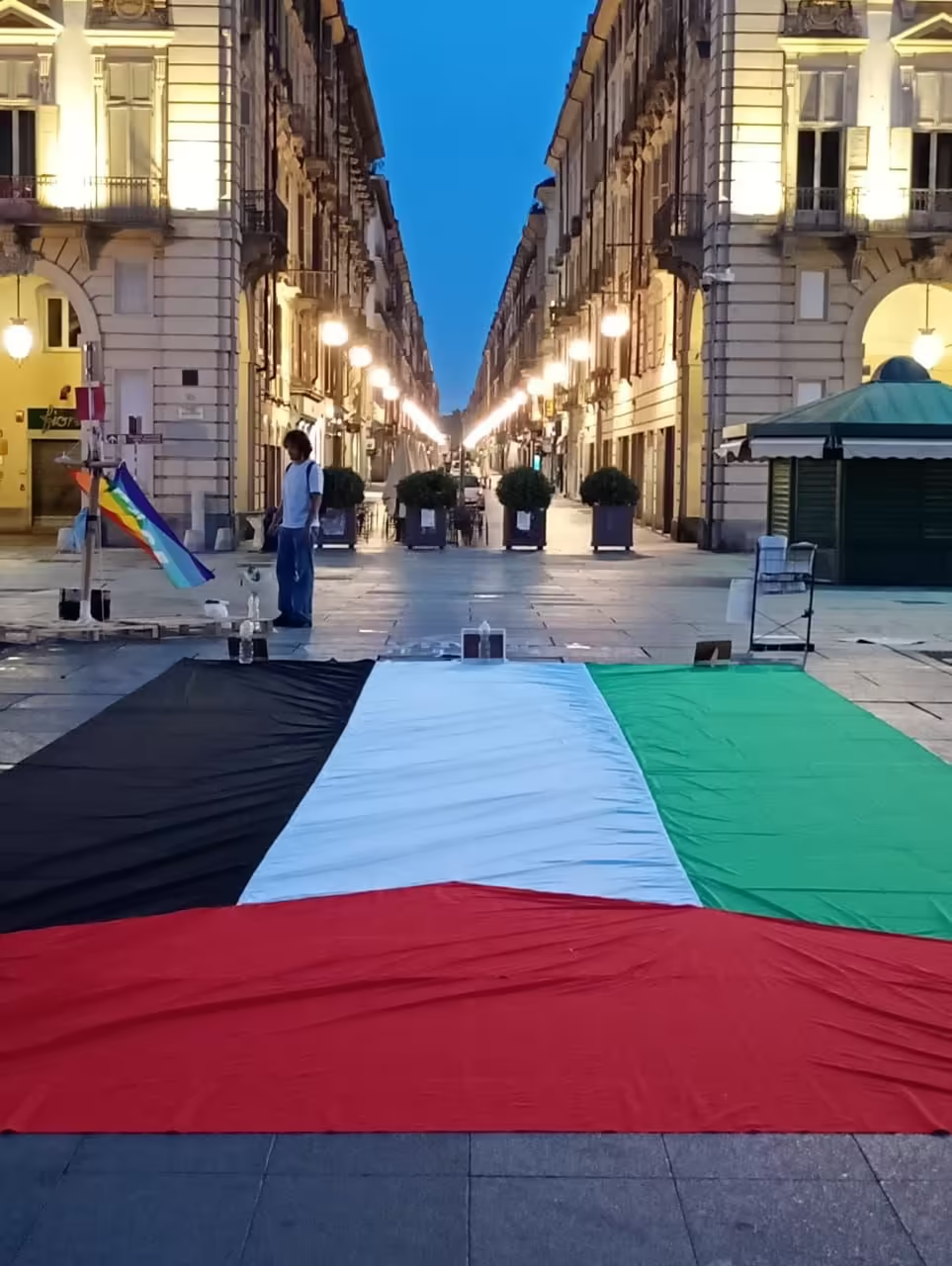
“Our lives have come to a halt. We cannot see anything but genocide, which has taken the place of our dreams.”
Since May 19, 2025, some students from a communications degree program decided to sit in Castello Square (Turin) and have not stood up since. Thus was born a permanent, nonviolent garrison for Palestine, which several other volunteers joined. With their huge flag, tents, thousands of writings and various artistic events, they tried to speak to the world to stir consciences: their constant presence reminds us, night and day, that there is still a light of humanity burning; that there is still someone who resists the obnoxiousness.
At the beginning at the garrison there was an atmosphere of courage and hope. With some parents we organized moments of reading fairy tales on the theme of war with our daughters and sons. That’s how we got to know each other.
Now the atmosphere has changed. Faced with the inaction of our governments, but also of the city around them, with its load of indifference; looking at the destruction of Gaza, overwhelmed by the atrocious images and distressed voices of the people they are in contact with through Instagram, these young men and women falter: there are those who wake up in the middle of the night to read the words of Gazawi families asking for help, declaring that they can’t take it anymore, that they are on the verge of despair because of what is happening.
Continuously animating the garrison are about eight people. One of the most active and sensitive activists tells us that since the presidium began, it is as if his life has in some ways stopped. He tells about one image in particular. The one that has disassociated him from the Western world. An image that returns, overlapping everything, like a sacred obsession that opened his eyes and that he claims to revere. “A child stuck under rubble with his mouth caked with dust and blood. And in his barred eyes, the last look locked in horror.” In his world made up of images, in his dream as a filmmaker, that of the child has become an endless fuel that drives him to fight in the hope of a better world, without respite. Because every time he stops, every time he slows down, that gaze grows sharper. “Only when there is a point to this atrocity” – he says – “will I be able to close my eyes to that soul and draw on its face the smile it deserves.” There is no more time to talk to his family, to watch a movie in the evening, to go out with friends. You go to bed late, to keep watch. You get up at dawn, to check the news, read articles about the war, and wonder, every day, what you can do to break the wall of indifference. “It’s a feeling that tears at your head from the inside,” explains a young woman in the group. “Physically, all the things you propose to do don’t fit in your brain, and you collapse psychologically, you freak out, helpless” when faced with images of children being slowly starved to death. “Talking doesn’t work, art doesn’t work, you get the urge to do actions that you might regret–like against yourself.” Among activists it is not uncommon to hear about forms of “collective suicide”: if you just left the gas on or took a motorcycle, off you go, straight to Gaza or as close as you can get … When they talk about it they are serious. They are ideas for real.
The garrison becomes both a form of support and a trap. If some suggest suspending it momentarily — in a city in August deserted — others insist that that space is the only symbol that says there is a network of people, that you are not alone. It is “the only form of psychological support that sends you back the fact that you are doing something, so in order not to collapse, you keep fighting.” And you find yourself “enslaved” inside a mechanism of indifference and a world that looks the other way.
It is too much. If I were to carry out the practice of medicine and psychotherapy as I was taught – in my university years, first, and in graduate school, later – I would be tempted to understand the words spoken by these young people within psychopathological frameworks that already exist in diagnostic manuals; my experience at the Frantz Fanon Center in Turin, however, takes me in another direction. The forms of moral panic that I have encountered in these months at the presidium are the reaction that can be expected from people who do not want to detach themselves from the world in which they live and who interact with an environment that has become unlivable. So it is we who must hold together the psychic and the political, the individual and the social if we are to understand what these young people are suffering from.
We are all today direct witnesses to genocides that were once hidden, ignored or denied. With this in mind, are these young people not carrying on their shoulders the burden that most “adults” have decided, after all, not to carry? Aren’t their despair and tears the ones we fail to shed? They certainly suffer from the helplessness that the images of extermination and malnutrition send back to us, but is it not rather the loneliness caused by the indifferent world around them that is driving them to despair? That world that is currently packing their bags for the sea?
We have abandoned them and in doing so have perhaps abandoned ourselves, as happened to the Fridays For Future children or those demonstrating for peace in Ukraine. If I had to as a doctor make a diagnosis, it would then be this: “acute stress disorder caused by genocide and world sloth.”1 Therapeutic prescription: social mobilization of all generations in support of Gaza. Direction to all media (radio, newspapers, television): give voice to the girls and boys of Palestine Square.
There is a way to respond to the great feeling of helplessness and loneliness that young people experience in the face of the disasters of the present: to squeeze all together “in social chain,”2 give voice and legs to that “cry in search of a mouth” that Gaber spoke of3 already many years ago: act now. It is never too late.
I therefore conclude with the words of the Palestine Square youth and a call for mobilization.
“The Palestinian cause, in this context, represents […] an opportunity to bring back to the center of human action the dream of an unarmed world, in which war is no longer justifiable, conceivable, nor culturally acceptable. A world in which peace is no longer a utopia, but a permanent condition of human coexistence.”
Anyone, before or after the vacations, who would like to help out (even one hour a day or month), can fill out the following form.
Jean-Louis Aillon
Adlerian physician and psychotherapist – Frantz Fanon Association
Lecturer in Ethnopsychiatry at the University of Turin
- From a clinical point of view, one could speak of “live genocide.” If the genocidal device repeats its elimination project with the same techniques used in the past in similar situations (physical elimination, starvation, lack of drinking water and other vital resources, sexual violence, etc.), today the fundamental difference lies in the accessibility of information in real time, which exposes people who indirectly witness the horrors to vicarious traumatic experiences. ↩︎
- Giacomo Leopardi (1845), The Broom or the Flower of the Desert, in: Canti, Ranieri: Florence. ↩︎
- Giorgio Gaber (1998), The Cry, CD: Hard-won idiocy. ↩︎